Why OEMs Are Re-Evaluating Global Sourcing
Manufacturers today face constant disruptions, including rising tariffs, supply chain volatility, and increasing pressure to deliver faster with fewer errors. For OEM engineers, plant managers, and procurement leaders, the traditional model of offshoring to the lowest-cost region no longer guarantees the lowest total cost. That’s why nearshoring manufacturing has gained traction as a strategic alternative, moving production closer to end markets, often to Mexico or Canada for US customers. This article breaks down the true differences between nearshoring vs offshoring across:
- Cost
- Supply chain risk
- Lead times
- Operational control
…and explains how OEMs can make smarter sourcing decisions in today’s environment.
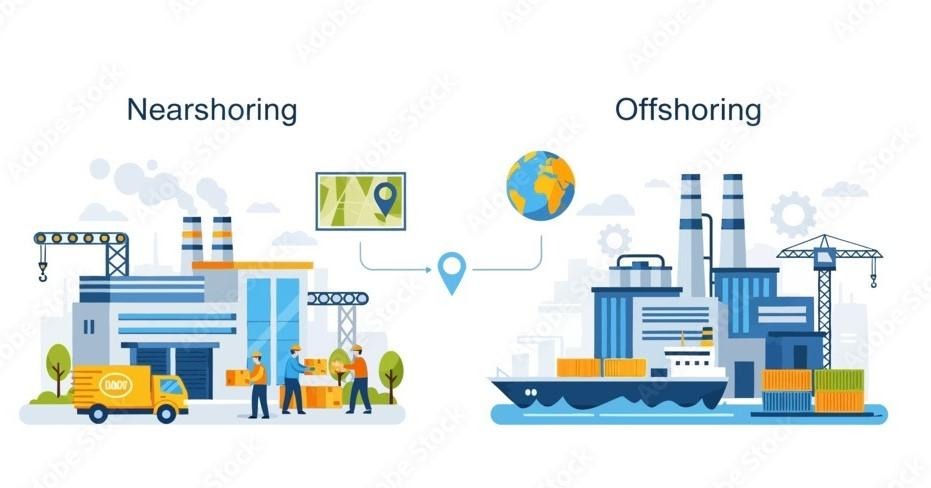
What is Offshoring in Manufacturing
Offshoring refers to producing components in distant, low-cost countries such as China, India, or Vietnam. The appeal is straightforward: significantly lower labor costs and access to large-scale production infrastructure.
A stamped component that costs $1.00 domestically may cost a fraction of that offshore. However, that cost advantage is often misleading when viewed in isolation.
Once OEMs factor in logistics and operational realities, additional costs quickly emerge:
- Ocean freight and fuel volatility
- Tariffs, duties, and compliance requirements
- Long lead times require excess inventory
- Risk of obsolescence during design changes
These variables make the total landed cost far less predictable and often much higher than expected.

What Nearshoring Changes
Nearshoring brings production closer to the end market, typically within the same region or time zone. For U.S.-based OEMs, this often means sourcing from Mexico, Canada, or domestic suppliers.
While the piece price is typically higher than offshore, the strategic advantages become clear when evaluating the full supply chain. Shorter transit times, easier communication, and greater supplier access allow OEMs to operate with far more agility and confidence.
Instead of managing uncertainty, nearshoring enables manufacturers to actively control outcomes.
Nearshoring vs Offshoring: Key Difference for OEM Manufacturers
Cost: Beyond the Piece Price
The most common mistake in sourcing decisions is focusing only on unit cost. Offshoring wins on piece price, but that’s only one part of the equation.
When OEMs evaluate total landed cost, the picture changes. Offshore sourcing introduces layers of expense that are often underestimated, particularly when disruptions occur. Expedited freight, production delays, and excess inventory can erode initial savings quickly.
Nearshoring shifts the cost structure. While upfront pricing is higher, it reduces the hidden financial burdens that impact profitability.
Key cost advantages of nearshoring include:
- Lower inventory carrying costs due to faster replenishment
- Reduced freight complexity and volatility
- Minimal tariff exposure under regional trade agreements
- Fewer emergency production or shipping expenses
In many cases, OEMs find that nearshoring delivers a more stable and ultimately lower total cost of ownership.
Lead Times: From Months to Days
Lead time is one of the most visible differences between offshoring and nearshoring.
Offshore production often requires a full cycle of manufacturing, ocean freight, customs clearance, and final delivery. Even under ideal conditions, this process typically spans 9 to 12 weeks.
Nearshoring compresses that timeline dramatically. Production timelines may be similar, but transportation is reduced to days instead of weeks. This shift has a direct impact on how OEMs operate.
Shorter lead times allow manufacturers to:
- Respond quickly to demand changes
- Reduce safety stock requirements
- Accelerate prototyping and design revisions
- Improve overall production flexibility
Instead of forecasting months in advance, OEMs can operate with real-time responsiveness.
Supply Chain Risk: Exposure vs Resilience
Offshore supply chains are inherently complex. They span multiple countries, transportation modes, and regulatory environments. This complexity creates vulnerability.
A single disruption, such as a port shutdown, geopolitical conflict, or factory delay, can halt production for weeks or longer. For OEMs operating on tight schedules, that level of exposure is difficult to absorb.
Nearshoring reduces that risk by simplifying the supply chain. Shorter distances and fewer handoffs create a more resilient system. When issues arise, they can be addressed quickly rather than escalated across continents.
For OEMs, this means fewer surprises, faster recovery, and greater confidence in delivery timelines.
Operational Control in Nearshoring vs Offshoring: The Defining Advantage
While cost and lead time are critical, operational control is often the deciding factor for OEMs.
Offshoring limits visibility. Distance, time zone differences, and language barriers make it difficult to maintain consistent oversight. When issues occur, resolution is slow and costly. Site visits require significant time and expense, which reduces their frequency.
Nearshoring changes that dynamic completely. OEMs gain direct access to their suppliers, enabling stronger collaboration and faster decision-making.
With nearshoring, manufacturers benefit from:
- Real-time communication within aligned time zones
- Frequent, low-cost supplier visits and audits
- Faster identification and resolution of quality issues
- Greater control over production schedules and priorities
This level of access translates into better quality, fewer delays, and stronger long-term supplier relationships.
Choosing the Right Strategy Between Nearshoring vs Offshoring
There is no one-size-fits-all answer. Offshoring still makes sense for high-volume, low-complexity components with stable demand. However, for OEMs dealing with tight tolerances, evolving designs, or time-sensitive production, nearshoring offers a clear advantage.
The key is to move away from default decisions and toward strategic sourcing based on total impact.
Partner With ITD Precision
For OEMs looking to strengthen their supply chain, ITD Precision delivers the benefits of nearshoring through reliable U.S.-based manufacturing. With decades of expertise in precision metal stamping, ITD helps manufacturers reduce risk, improve responsiveness, and maintain consistent quality. Engineering collaboration is direct, lead times are short, and production remains fully within your control.
If your operation can’t afford delays, quality issues, or supply chain uncertainty, it’s time to rethink your sourcing strategy. Contact ITD Precision today to take control of your manufacturing supply chain.