Disk packs are the heart of high-performance flexible couplings, engineered to transmit torque precisely while accommodating shaft misalignment. In modern power transmission systems, especially in industries demanding reliability under extreme conditions, disk packs ensure operational continuity by balancing flexibility with torsional stiffness. These critical elements are common in high-speed rotating machinery such as compressors, turbines, servo motors, and aerospace actuators, where failure is not an option. This article explores the disk pack anatomy, materials, design, performance features, and manufacturing considerations. Thus, providing insights for OEMs, engineers, and manufacturers looking to source or develop high-reliability torque transmission components
What Is a Disk Pack?
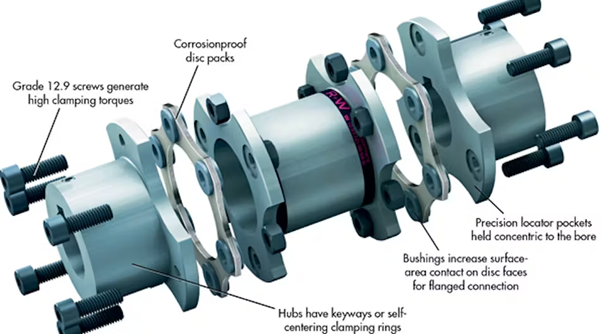
A disk pack is a mechanical assembly that consists of thin, high-strength metallic laminates arranged in parallel. Moreover, these individual disks are typically fastened together using bolts, bushings, or rivets, forming a flexible yet torsionally stiff element that connects two rotating shafts. Unlike rigid couplings, disk packs can tolerate angular, parallel, and axial misalignment while maintaining accurate torque transfer and minimizing backlash.
The number of disks, their thickness, material, and mounting configuration all contribute to the performance characteristics of the disk pack. Engineers commonly integrate disk packs into disc couplings, especially in precision machinery where vibration damping and high rotational accuracy are critical.
Material Selection for Disk Packs
The choice of material significantly influences a disk pack’s mechanical behavior, fatigue life, and environmental resilience. Disk packs must withstand repetitive stress cycles, high torque loads, and environmental factors such as heat and corrosion.
Common Material for Disk Packs
- Stainless Steel (AISI 304, 316, 17- 4PH): The most common material for disk packs due to its excellent corrosion resistance, high strength, and good fatigue life. Grade 304 is common for general industrial applications, while 316 offers a superior resistance to harsh chemicals and marine environments. Precipitation-hardened 17- 4PH stainless steel is ideal for high-stress applications.
- High-Strength Alloy Steels (AISI 4140, 4340): Common in heavy-duty industrial applications involving high torque and shock loads.
- Nickel-Based Super-Alloys (Inconel 718, Hastelloy): Suitable for high-temperature environments, especially gas turbines and exhaust systems.
- Composite Materials: Prevalent in high-speed, lightweight applications where traditional metals may introduce excessive inertia.
Manufacturers often treat these materials through annealing or precipitation hardening processes to enhance mechanical performance. Moreover, material uniformity and metallurgical consistency are essential to prevent fatigue cracking under dynamic loads.
Disk Pack Design and Configuration
Engineers design disk packs in various configurations to match specific application needs. A well-designed disk pack balances flexibility, load capacity, and dimensional constraints.
Key design considerations include:
- Single vs. Multi-Disk Packs: Single-disk packs provide minimal compliance, while multi-disk packs offer greater flexibility for accommodating misalignment.
- Parallel vs. Series Arrangement: Engineers configure disk packs in parallel to increase torque capacity or in series to manage higher misalignment.
- Spacer Designs: Spacers between disks help maintain consistent spacing, reduce stress concentrations, and facilitate heat dissipation.
- Bolt Hole Patterns and Interfaces: The geometry of attachment interfaces ensures uniform load distribution and alignment with mating hubs.
Performance Attributes
Disk packs demonstrate high mechanical performance under dynamic conditions. Their defining attributes include:
- High Torque-to-Weight Ratio: Enables efficient transmission of mechanical power without adding unnecessary mass.
- Torsional Rigidity: Maintains shaft alignment during torque transfer, crucial for servo control and precise motion systems.
- Zero Backlash Operation: Disk packs transmit torque with no play, ensuring accurate load responsiveness.
- High RPM Capability: Balanced, lightweight construction allows operation in high-speed systems without inducing harmful vibrations.
- Fatigue Resistance: Layered construction and material resilience enable long service life under cyclic loading.
Manufacturing Disk Packs at ITD Precision
ITD Precision employs a vertically integrated approach to disk pack manufacturing. Our production processes ensure consistency, performance, and scalability, from prototyping to high-volume production. Key manufacturing processes include:
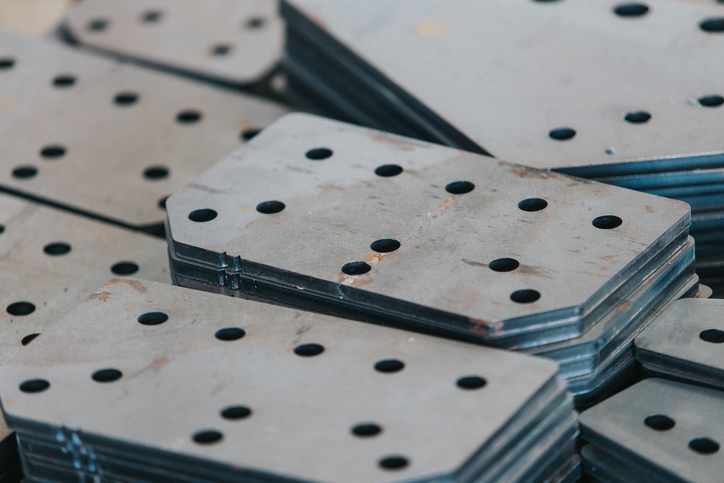
- Stamping: High-speed stamping serves for large production runs, maintaining tight tolerances in disk diameter and bolt hole placement.
- Laser Cutting and Wire EDM: Ideal for intricate geometries or prototyping. These methods allow precision control of disk shape, especially for aerospace or medical applications.
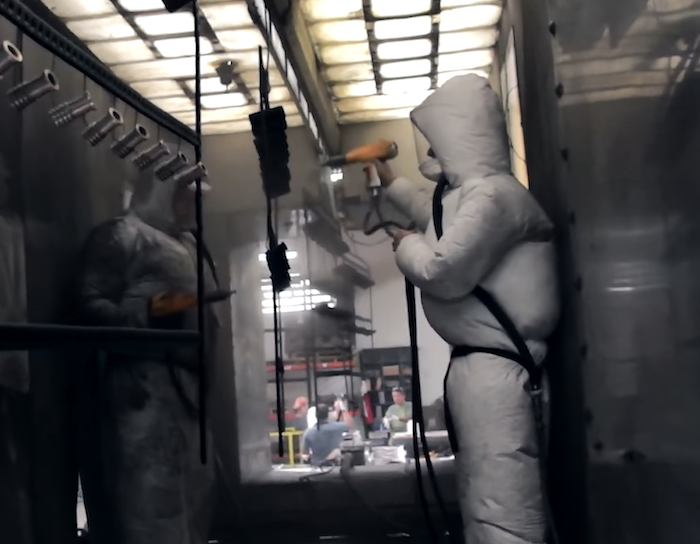
- Post-Processing Treatments: We use deburring, heat treatment, and surface passivation to enhance mechanical properties, fatigue strength, and corrosion resistance.
Technicians produce each disk pack with uniform thickness and flatness to minimize out-of-plane stresses and ensure long-term reliability.
Testing and Quality Assurance
Reliability is non-negotiable in critical applications. At ITD Precision, we incorporate rigorous testing and inspection protocols to validate the mechanical integrity of every disk pack.
Our QA process includes:
- Static and Dynamic Load Testing: Confirms disk pack behavior under operational loads.
- Fatigue Validation: Simulates long-term operational stresses to evaluate endurance limits.
- Dimensional Inspection: Uses precision metrology tools to verify tolerances on disk thickness, outer diameter, bolt holes, and concentricity.
- Surface Finish Evaluation: Ensures smoothness to reduce friction wear and minimize initiation points for cracks.
The ITD Precision team maintains traceability and process documentation throughout the production cycle to support aerospace and medical compliance standards.
Applications of Disk Packs
- Aerospace Actuators: Disk packs maintain torque accuracy in flight control systems where failure could compromise safety.
- Servo Motors and Robotics: Zero-backlash torque transmission is vital for position accuracy and repeatable motion.
- Pumps and Compressors: Disk packs tolerate alignment shifts caused by thermal expansion or baseplate movement.
- Medical Devices: Compact and precise, disk packs are ideal for surgical robots and imaging equipment.
- Renewable Energy Systems: Wind turbines and solar tracking systems rely on disk packs for efficient, maintenance-free torque transfer.
Each application imposes specific requirements on material, stiffness, and environmental resistance; hence, ITD Precision customizes disk pack designs to exact specifications.
When to Replace a Disk Pack
Although disk packs are designed for durability, they are not immune to wear. Knowing when to replace a disk pack can prevent unplanned downtime or equipment failure.
Signs indicating replacement include:
- Fatigue Cracks or Fractures: Especially near bolt holes or high-stress zones.
- Visible Wear or Warping: Suggests overloading or misalignment beyond design tolerance.
- Loss of Torsional Stiffness: May result in backlash, excessive vibration, or imprecise motion.
- Scheduled Maintenance Intervals: Replacement may be recommended after a specific number of operating hours, especially in safety-critical applications.
Routine inspection with high-resolution optical or ultrasonic tools can detect early-stage wear before functional failure occurs.
Partner with ITD Precision for Disk Pack Excellence
Disk packs are more than just components—they are precision elements that define the performance, reliability, and longevity of your power transmission system. From material selection and design to manufacturing and testing, every detail matters.
ITD Precision is your trusted partner for disk pack solutions tailored to demanding industrial applications. Our deep manufacturing capabilities, engineering expertise, and commitment to quality make us the go-to choice for OEMs seeking high-performance, U.S.-manufactured components.
Contact us today to discuss your disk pack requirements, request a quote, or start co-developing your next innovation in power transmission.