Conformal and conventional cooling are key methods for managing heat in injection and insert molding processes. This article compares both approaches, examining their design, thermal efficiency, and impact on cycle time, part quality, and tooling complexity. Learn which cooling strategy offers the best performance for insert molding applications and how conformal cooling changes the game in modern mold design.
The Basics of Cooling in Insert Molding
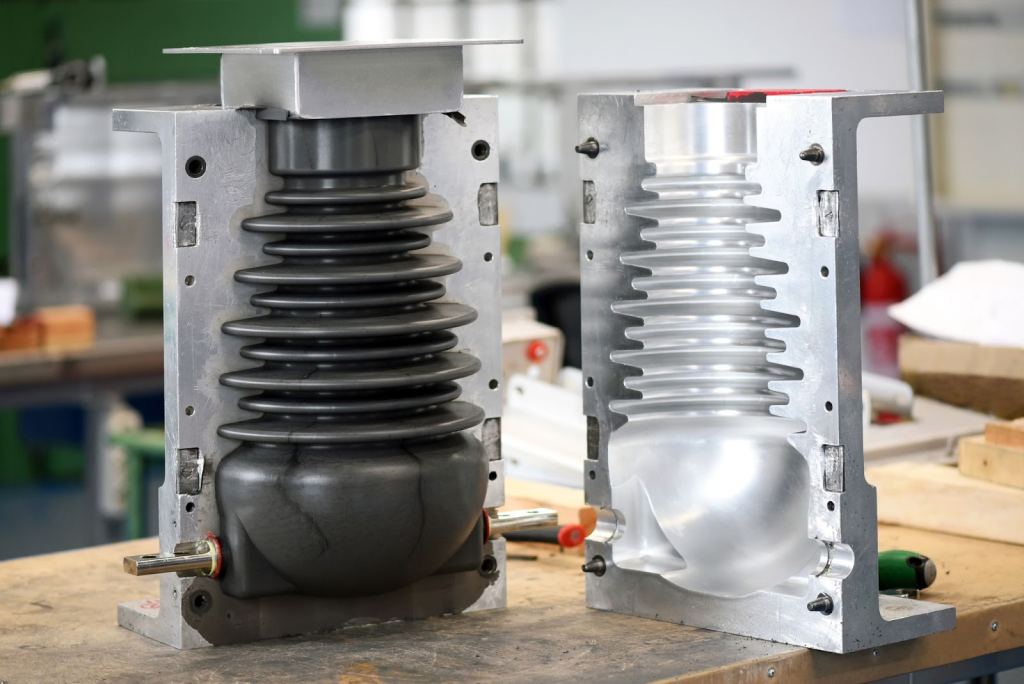
Insert molding begins with heat introduced by the molten polymer or composite material, which is injected into the mold cavity. This cavity is heated to a precise temperature tailored to the material’s viscosity and thermal characteristics, ensuring optimal flow. As the molten material fills the cavity, heat quickly transfers to the cooler mold and insert, which act as effective heat sinks. To remove this heat efficiently, the mold incorporates strategically placed cooling channels—either traditional straight-drilled passages or advanced conformal channels that follow the mold’s geometry. These channels play a vital role in drawing out heat uniformly, enabling controlled solidification of the part.
Cooling isn’t just a passive phase—it’s a critical step that directly affects dimensional accuracy and part quality during insert molding. By actively managing the cooling rate, manufacturers can maintain tight tolerances and ensure precise alignment between the molded part and the insert. Moreover, adjusting the cooling rate allows for manipulation of the microstructure in semi-crystalline polymers. This control helps achieve specific performance traits, such as enhanced mechanical strength, greater chemical resistance, or improved optical clarity, depending on the application.
What Is Conventional Cooling?
Conventional cooling refers to the traditional method of managing mold temperature using straight, drilled channels to circulate a coolant—typically water or a water-glycol mixture. These channels are created using standard machining techniques like gun-barrel drilling, resulting in linear paths that often run parallel to the mold surface. However, due to the geometric limitations of drilling and milling tools, these cooling channels can only follow straight lines and simple patterns.
When channels cannot be machined directly into the mold inserts, they are instead placed in the bolsters or support blocks. While this method remains cost-effective and easy to maintain, it comes with significant drawbacks. Because of their rigid geometry, these channels can’t follow complex contours, often causing uneven heat removal in intricate molds. This uneven cooling can cause thermal gradients, which in turn increase cycle times and raise the likelihood of defects such as warpage, sink marks, or residual stress.
Moreover, because straight-line channels cannot follow the natural curves of complex parts, they leave behind hot spots where cooling is less effective. Despite these limitations, conventional cooling continues to be widely used, especially for high-volume production of simple parts—due to its affordability, compatibility with standard tool steels, and ease of repair. Ultimately, its effectiveness hinges on smart channel placement and process control, but it still falls short of the precision achieved with conformal cooling.
What Is Conformal Cooling?
Conformal cooling is a modern, high-performance approach to mold temperature control in insert molding. Unlike traditional methods, it uses advanced manufacturing technologies—such as Direct Metal Laser Sintering (DMLS) or Selective Laser Melting (SLM)—to create cooling channels that follow the complex 3D contours of the mold cavity. These channels are designed to closely match the shape of the molded part, allowing coolant to flow much closer to the mold surface.
By closely matching the mold’s contours, conformal channels extract heat more uniformly and quickly, cutting cooling times and minimizing temperature variation. The consistent cooling improves part quality, lowers the risk of warpage or sink marks, and boosts dimensional stability. Additionally, conformal cooling can reach tight, hard-to-cool areas—such as undercuts, thin walls, or intricate features—making it ideal for complex or high-precision parts.
The advantages are clear: faster cycle times, better energy efficiency, improved part performance, and higher throughput. However, this technology does come with challenges. Creating conformal cooling channels requires a higher initial investment, specialized design expertise, and simulation tools to optimize flow paths. It also demands the use of premium alloys like maraging steel, and may require post-processing steps such as heat treatment or polishing. Though initially more expensive, conformal cooling offers long-term gains in productivity and part quality for complex molding applications.
Side-by-Side Comparison: Conformal Cooling vs. Conventional Cooling
Impact on Insert Molding Performance
The table below shows the difference between conformal vs conventional cooling methods in different aspects.
| Aspect | Conformal Cooling | Conventional Cooling |
| Cooling Efficiency | High efficiency due to channels mirroring mold contours, enabling uniform heat removal and eliminating hot spots. | Moderate efficiency due to the linear channel creating uneven cooling, leading to thermal gradients. |
| Best Use Cases | Complex and high-precision parts like medical devices and micro-electronic parts. | Simple parts and less complex tools, such as day-to-day consumer goods. |
| Design Flexibility | Highly flexible, as its channels can follow complex 3D contours. | Limited to straight drilled channels, restricting it to simple geometries. |
| Cycle Time Reduction | High reduction in cycle time via optimized heat extraction. | Low reduction in cycle time, due to inefficient cooling in complex geometries. |
| Tool longevity | Longer lifespan due to reduced thermal fatigue and stress from uniform cooling. | Shorter lifespan in high-stress applications due to uneven thermal cycling. |
| Manufacturing Cost | High upfront manufacturing cost. | Low upfront manufacturing costs. |

When to Choose Conformal Cooling vs Conventional Cooling
Choosing between conformal and conventional cooling depends on several factors, including part complexity, material sensitivity, required tolerances, and production volume. Here’s a breakdown of when each method is most appropriate:
Choose Conformal Cooling When:
You’re Molding Parts with Multi-Material Inserts
Inserts made of dissimilar materials—such as aluminum paired with plastic—dissipate heat unevenly. Conformal cooling enables custom-designed channels that balance cooling across the insert, preventing distortion and ensuring consistent part quality.
Tight Tolerances and High Precision Are Critical
For precision applications—like bonding titanium surgical tools or molding electronic connectors with gold-plated pins—conformal cooling minimizes thermal distortion and maintains tolerances under ±0.05 mm. Uneven cooling in these cases can misalign delicate components or create bonding issues.
The Part Has Complex Geometry
Parts with thin walls, deep ribs, or undercuts often can’t be cooled effectively using straight-line channels. Conformal cooling closely follows complex contours, maintaining uniform proximity to critical zones and improving part integrity.
You’re Working with Thermally Sensitive Materials
Polymers like PEEK or carbon-fiber-reinforced nylons require rapid, even cooling to avoid degradation. Conformal cooling ensures consistent solidification, which helps preserve the polymer’s crystallinity, fiber alignment, and final mechanical properties.
You Need to Maximize Cycle Time Efficiency
Shorter cycle times mean greater output and profitability, especially in high-volume fields like consumer electronics. For example, conformal cooling reduces the cooling phase time by up to 66% in smartphone casing production, especially in thick, metal-embedded sections that would otherwise cool unevenly.
Choose Conventional Cooling When:
You’re Producing Simple, Geometrically Basic Parts
If the part design is relatively straightforward—without undercuts, deep features, or tight tolerance zones—conventional cooling provides sufficient performance at a lower cost.
Your Project Has Tight Budget Constraints
Conventional cooling is significantly less expensive to implement. It uses common machining techniques and standard materials, making it ideal for low-cost tooling or prototype runs.
Maintenance and Repair Are a Priority
In environments with frequent cycling, repairs, and modifications of tools, conventional cooling systems offer easier access and lower maintenance complexity.
Cycle Time Is Not a Critical Factor
For lower production volumes or non-time-sensitive applications, the longer cooling cycles associated with conventional cooling may be acceptable. This is especially when weighed against lower tooling costs.
Partner with ITD Precision for Smarter Insert Molding Solutions
Whether your application demands the geometric flexibility of conformal cooling or the cost efficiency of conventional cooling, ITD Precision has the expertise to match the right cooling strategy to your unique requirements. Our insert molding services come from decades of experience, advanced equipment, and a commitment to precision. So, you can be sure of optimal part quality, minimal cycle times, and reliable performance when working with ITD.
As one of the few U.S. metal stamping companies offering insert molding, E-Coating, and heat treating under one roof, we deliver streamlined, end-to-end solutions that save you time and reduce production costs. With vertical rotating molding machines ranging from 70 to 280 tons, centralized material systems, and AIAG CQI-23 compliance, our operations deliver quality and repeatability.
From simple overmolded parts to complex, high-tolerance components, we bring your insert molding project to life.
Contact ITD Precision today to learn how our integrated capabilities and smart cooling strategies can elevate your next production run.