Flex couplings play a critical role in connecting rotating equipment and managing misalignment. This article explores how they work, their types, design considerations, and why ITD Precision is your trusted partner for precision-manufactured flex couplings.
The Role of Flex Couplings in Industrial Applications
Flex couplings are mechanical components with a design that allows them to connect two rotating shafts. The couplings achieve this while accommodating various forms of misalignment, absorbing vibrations, and transmitting torque between them. By absorbing shocks and vibrations, a flex coupling enhances operational smoothness, particularly in high-speed or high-torque systems such as pumps, compressors, and conveyors, ensuring stable performance and minimizing downtime. Their ability to handle thermal expansion and dynamic loads makes them indispensable in harsh environments like steel mills. In these harsh working environments, temperature fluctuations and mechanical flexing are common.
How Flex Couplings Work
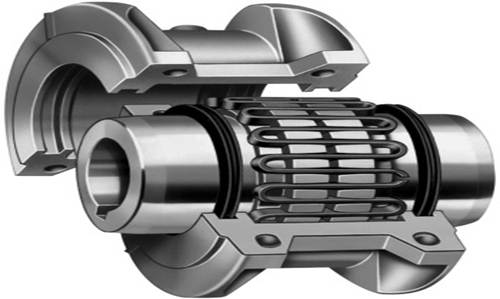
The working principle of a flex coupling depends on its mechanical design. These couplings consist of two hubs and a flexible element, such as an elastomeric spider, metallic grid, or helical beam. This flexible element is key because it allows controlled movement between the shafts. The element deforms elastically under stress, enabling the coupling to perform its critical functions without rigidly binding the shafts. When torque is applied, the coupling transmits rotational force while accommodating slight deviations in alignment and mitigating shock loads.
Key Functions of Flex Couplings:
Torque Transmission
Flex couplings efficiently transfer rotational power (torque) from one shaft to another, even under misaligned conditions. The flexible element, whether a rubber insert, metal spring, or sliding disc, ensures that torque is transmitted smoothly without slippage.
Misalignment Compensation
Flex coupling accommodates three types of misalignment:
- Angular misalignment (shafts at a slight angle to each other).
- Parallel misalignment (shafts offset but parallel).
- Axial misalignment (shafts moving closer or farther apart axially).
Vibration Damping
The flexible elements in couplings absorb and dissipate vibrations generated by unbalanced loads, motor pulsations, or resonance in rotating systems. Elastomeric materials like polyurethane or rubber are particularly effective at dampening high-frequency vibrations.
Shock Load Absorption
Flex couplings act as buffers by temporarily deforming to absorb transient forces caused by sudden starts, stops, or load changes. Shock loads can damage connected machinery if not properly absorbed.
Types of Flex Couplings
There are several types of flex couplings, each designed for specific applications and performance requirements. Selecting the right one depends on load conditions, operating speeds, alignment accuracy, and space constraints.
Jaw Couplings (Elastomeric Couplings)
Jaw couplings consist of two metallic hubs with interlocking jaws and an elastomeric spider insert positioned between them. These couplings excel in applications requiring vibration damping and shock absorption, thus making them suitable for electric motors, pumps, and light to medium-heavy-duty machinery.
Oldham Couplings
Oldham couplings are three-piece flexible couplings consisting of two hubs with slots and a floating center disk with perpendicular tongues that slide within the slots. These couplings are particularly effective in applications requiring precise motion control with zero backlash, such as printers and small servo-driven systems.
Beam Couplings (Helical Couplings)
Beam couplings are single-piece flexible couplings machined from a solid metal bar, typically aluminum or stainless steel. The machining follows a helical cut pattern, thus creating spring-like flexibility. As a result, beam couplings are common in precision motion control systems like servo motors, encoders, and medical devices. In these applications, accurate torque transmission and minimal rotational deflection are critical.
Grid Couplings
Grid couplings utilize a spring-like steel grid positioned between two grooved hubs to transmit torque while accommodating misalignment and absorbing shock loads. These couplings are common in heavy-duty industrial environments such as mining equipment, crushers, and paper mills.
Disc Couplings
Disc couplings employ flexible metallic discs, usually stainless steel, to connect shafts while providing exceptional torsional rigidity and misalignment accommodation. They are ideal for high-speed and high-precision applications such as CNC machinery, robotics, and aerospace actuators.
Materials and Manufacturing Considerations
Material selection and manufacturing processes are critical to flex coupling performance, durability, and suitability. Couplings must withstand mechanical stress, environmental exposure, and cyclic loading while maintaining alignment and torque transmission. Processes for consideration during flex coupling production are machining, additive manufacturing, forging, casting, injection molding, welding, and bonding.
Common Materials for Flex Couplings
- Steel Alloys: Common materials for flex couplings due to their high strength and resistance to wear.
- Aluminum: Lightweight alternative, ideal for beam and disc couplings.
- Elastomers: Provide flexibility and vibration damping for jaw and tire couplings.
- Bronze and Brass: Prevalent in specialized couplings, especially applications requiring resistance to seawater corrosion or non-sparking properties.
- Titanium: Preferred in aerospace and medical applications for its exceptional strength, lightweight, and corrosion resistance.
Flex Coupling Design Factors to Consider
When designing or selecting a flex coupling, engineers must consider several parameters such as:
| Parameter | Consideration and Reasons |
| Torque Requirements | Choose a coupling with torque capacity exceeding system demands to prevent overload failure. |
| Misalignment Types | Ensure the coupling accommodates the type and degree of misalignment present. |
| Operation Speed | High-speed systems like turbines require precision-balanced couplings to minimize vibration. |
| Maintenance Requirement | Consider maintenance-free designs like disc or elastomeric couplings, thus reducing downtime |
| Cost vs Lifespan | Elastomeric couplings are cost-effective but wear faster, while metallic couplings are more expensive but have a longer service life. |
Applications of Flex Couplings
Flex couplings are used across a wide range of industries, including:
Industrial Manufacturing and Machinery
Flex couplings are common in industrial manufacturing, where they serve in pumps, compressors, and conveyor systems.
Automotive and Transportation
In the automotive sector, flex couplings are integral to drivetrain systems, where universal joints accommodate angular misalignment in propeller shafts. Thus, ensuring smooth power delivery from the transmission to the wheels.
Aerospace
Aerospace applications demand couplings that can withstand extreme conditions while maintaining precision.
Energy and Power Generation
The energy sector leverages flex couplings in wind turbines, where gear couplings connect the rotor shaft to the generator. This makes the system capable of tolerating misalignment due to tower flexing and wind loads.
Marine and Offshore
Marine environments pose unique challenges, such as saltwater corrosion and constant vibration, which flex coupling addresses effectively.
Why ITD Precision for Flex Coupling Manufacturing
At ITD Precision, we specialize in high-precision, custom-engineered mechanical components, including flex couplings. Our vertically integrated capabilities allow us to control quality from raw material to finished part.
What Sets Us Apart:
- Multi-Process Expertise: We combine CNC machining, insert molding, stamping, heat treating, and e-coating—all in one facility.
- ISO-Compliant Quality: Our processes align with AIAG CQI-9, CQI-11, and CQI-23 quality standards.
- High Volume Capacity: With two locations and scalable production lines, we support both prototypes and full-scale production runs.
- Engineering Support: Our in-house engineers work with your team to optimize coupling design for performance and manufacturability.
When to Partner with ITD Precision
Whether you need to source a precision-engineered flex coupling or develop a new design for a complex application, ITD Precision offers:
- End-to-end manufacturing expertise
- Proven track record in high-reliability industries
- Flexible production volumes
- Fast turnaround and U.S.-based support
Looking for a reliable partner to manufacture or co-develop your next flex coupling? Contact ITD Precision today. Our team is ready to bring your concept to life—from tooling to production—with the quality, precision, and expertise that industry leaders trust.