Disk pack couplings play a pivotal role in precision engineering. Moreover, they connect rotating shafts, accommodate misalignments, and maintain seamless torque transmission across critical applications. This article explores what disk pack couplings are, how they work, and why industries like aerospace, energy, medical, and robotics rely on them. We’ll also cover their design features, materials, manufacturing processes, and quality standards. By the end, you’ll understand why disk pack couplings remain an ideal choice for precision-driven environments and how ITD Precision can help you design and manufacture a coupling tailored to your specific needs.

What Are Disk Pack Couplings?
A disk pack coupling is a precision component that uses one or more sets of thin, high-strength metal disks, bolted alternately between hubs, to connect rotating shafts. This design allows for torque transmission while compensating for angular, parallel, and axial misalignments. Unlike gear-style or elastomeric alternatives, a disk pack coupling has no moving parts that wear over time. Thus, making it ideal for high-speed or precision environments.
Each disk flexes elastically within its limits, thus allowing it to adjust to misalignments. Also, this design maintains torsional rigidity and ensures accurate shaft synchronization. As a result, the coupling operates reliably at high speeds, making it ideal for equipment where precision and durability matter.
Advantages of Disk Pack Couplings
Disk pack couplings offer a host of benefits for industries that demand precision and reliability:
- Exceptional Torsional Rigidity: Maintain precise torque delivery, even during rapid acceleration or deceleration.
- Triaxial Misalignment Accommodation: Absorb angular, parallel, and axial misalignments without putting additional load on bearings.
- Zero Backlash: Maintain absolute rotational synchronization between connected shafts.
- Vibration Attenuation: Minimize vibrations by up to 80% compared to solid coupling alternatives.
- Maintenance-Free Operation: Operate reliably for years because of a lubrication-free design and a wear-free structure.
Designs and Configurations of Disk Pack Couplings
Disk pack couplings can be configured in various ways to suit specific torque, misalignment, and space constraints:
Single Disk Configuration
Generally suitable for low-torque applications, a single disk provides basic misalignment tolerance and suits smaller assemblies.
Parallel Multi-Disk Stack
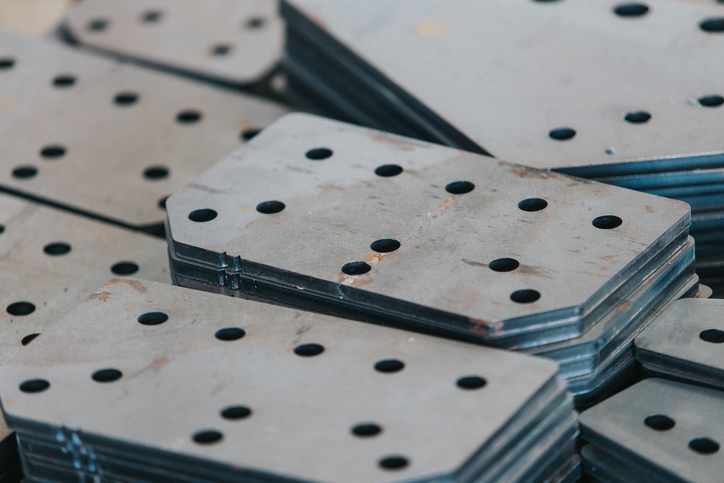
In this design, multiple thin disks are bolted in parallel between the hubs. The load is distributed across layers, thus making it ideal for higher torque and higher misalignment conditions.
Space-Integrated Design
This design features precision-ground spacers between disks to control deflection and prevent disk-to-disk contact. This is critical, especially for high-speed applications where there is a need to minimize friction-induced heat.
Convoluted (Waveform) Disks
Wave-shaped disks enable higher axial flexibility while preserving torsional rigidity. They are especially valuable in applications like steam turbines, where thermal expansion occurs.
Slotted/Etched Stress-Relief Design
Laser-cut radial slots or fractal etchings concentrate flexure in specific zones. This design reduces bending stress by 25%, thus enabling greater misalignment capacity.
Material and Manufacturing Process
Disk Pack Materials and Specifications
| Material | Specification | Features |
| Inconel 718 | AMS 5596 (sheet), AMS 5662/5663 | High strength at elevated temperatures. |
| Stainless Steels 17-7PH | AMS 5528 | Excellent fatigue and corrosion resistance |
| Titanium Ti-6AI-4V | AMS 4911 | Lightweight, high-strength, corrosion-resistant |
Hubs Materials and Specifications
| Material | Specification | Features |
| Inconel 718 | AMS 5662 (bar), AMS 5663(aged) | For high-temperature environments |
| Stainless Steel 15-5PH | AMS 5659 | Good strength and corrosion resistance |
| Aluminum Alloy 7075-T6 | ASM 4045 | Light-weight |
Performance requirements guide material selection for disk pack couplings, because each material offers distinct mechanical and economic advantages.
Design Considerations for Disk Pack Couplings
Choosing the right disk pack coupling means assessing several critical factors, including some of the following:
- Torque Capacity: Must be rated for both continuous and peak torque loads.
- Misalignment Tolerance: Angular, parallel, and axial misalignments must match design constraints.
- Speed and Balance: High RPM applications require precision-balanced assemblies to minimize vibration and resonance.
- Stiffness vs. Flexibility: Achieve the right balance for precision requirements and operational life.
- Maintenance Needs: Disk packs with lubrication-free designs reduce downtime and total cost of ownership.
Applications of Disk Pack Couplings Across Industries
Disk pack couplings are used in a range of industries:
- Industrial Automation: CNC machines, robots, and precision actuators.
- Medical & Semiconductor: MRI machines, surgical robots, and wafer handling equipment.
- Energy & Power Generation: Wind turbines, gas turbines, and oil & gas pumps.
- Aerospace: Flight control actuators, propulsion systems, and satellite positioning.
- Marine & Offshore: Ship propulsion, underwater robotics, and offshore drilling equipment.
Trends in Disk Pack Couplings
Smart Sensors
One emerging trend in disk pack couplings is the integration of smart sensor technology, enabling real-time monitoring of torque, vibration, and misalignment to predict maintenance needs and prevent unexpected failures in critical machinery.
Lightweight (Composite) Materials
Another significant advancement is the development of advanced composite materials. Generally, composite materials consist of carbon fiber with metal alloys, creating ultra-lightweight yet durable couplings. Moreover, these couplings offer superior vibration damping and corrosion resistance for aerospace applications.
Additive Manufacturing
Additive manufacturing techniques allow for complex, optimized disk geometries with internal cooling channels. These channels enhance heat dissipation and performance, especially in high-speed, high-temperature industrial environments.
Manufacturing Disk Pack Couplings at ITD Precision
At ITD Precision, we take a fully integrated approach to manufacturing disk pack couplings. Our in-house capabilities ensure precision across every stage of production:
- CNC Machining & Wire EDM: We manufacture every component with micron-level precision for tight tolerance and consistency across production runs.
- Heat Treatment & Surface Finish: We utilize annealing, hardening, and surface treatments like passivation to optimize durability, fatigue resistance, and performance.
- Dynamic Balancing & Testing: Every coupling undergoes precision balancing and inspection using coordinate and optical measuring machines, and torque testing.
By controlling every step of the process, ITD Precision delivers reliable, long-lasting disk pack couplings tailored to each client’s specifications.
Contact us today to discuss your requirements, request a quote, or collaborate with our engineering team. Let us help you build precision connections that drive performance and reliability.