Introduction
The efficiency and quality of a metal stamping operation largely depend on tool and die designs. At the core of this design is a crucial engineering choice, the configuration of the cavity, the precision void that shapes the metal. This single choice leads to two main production strategies: single-cavity and multi-cavity tooling. Each strategy affects cost, speed, and control. This article examines single-cavity vs multi-cavity tooling from a manufacturing science perspective. It also explains how choosing the right one directly impacts part consistency, production speed, and unit cost, helping to find the best setup for reliable, cost-effective production runs.
Understanding Single Cavity Tooling
What is Single Cavity
A single-cavity tool contains only one precision impression in the die set, producing a single part per press stroke. This approach concentrates the entire forming force and material flow into a singular operation. The concentration allows meticulous management of material behaviour during deformation, and direct control of key variables such as stretch distribution, wall thinning, and elastic recovery.
This precise control in a single-cavity tool is a prerequisite for manufacturing components with complex geometries or advanced materials. It is also essential for parts where surface finish and dimensional consistency are critical. However, this concentration limits production speed.

Key Characteristics of Single Cavity
Precision and Control for Complex Components
Single-cavity tooling excels at forming parts with complex geometries like deep draws or sharp radii because the focused force minimizes risks of splitting or wrinkling in critical areas. This allows for the use of advanced, less-formable materials such as high-strength steel, titanium alloys, and ultra-high-strength steel. By providing meticulous control over the entire strain path during deformation
Better Quality Over Volume
A single-cavity guarantees uniform quality by eliminating imbalance challenges. However, producing one part per stroke results in a higher cost-per-part at high volume. This establishes its strategic application of prioritizing part complexity, precision, and flexibility over maximum production throughput.
Simplified Execution
The single forming zone of the single-cavity streamlines setup, troubleshooting, and process adjustments. Thus, making it ideal for prototypes, engineering changes, and low-to-medium volume production.

Understanding Multi-Cavity Tooling
What is Multi Cavity
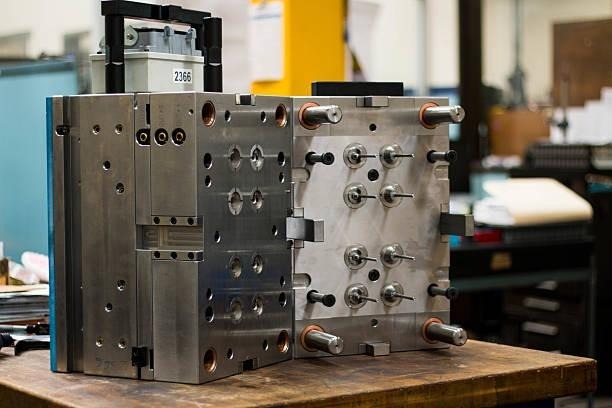
A multi-cavity tool contains multiple identical impressions within a single die set, allowing for the production of several parts per stroke. Moreover, the engineering process requires a balanced layout to ensure uniform material flow and force distribution. This demands sophisticated simulation and precision machining of synchronized cavities. Rigorous try-out and fine-tuning are essential to achieve consistent quality across all stations.
This balanced production in a multi-cavity tool is engineered for achieving maximum output of identical components. It is the fundamental approach for parts where minimizing cost-per-part dictates project economics. However, this configuration demands a finalized design and higher initial tooling investment.
Key Characteristics of Multi-Cavity
Complex Execution
A multi-cavity configuration requires machining every cavity to identical specifications with perfect alignment and complexity. The complexity extends to setup and maintenance, thus uniform management of consistent wear and performance across all cavities throughout the production run is necessary.
Engineered for High-Volume Economics
Multi-cavity tooling is ideal for high volumetric output and minimal unit cost. It drastically increases production rates by making multiple parts per press cycle. This approach distributes the substantial initial tooling investment across thousands of parts.
Volume Over Flexibility
Multi-cavity tooling delivers unparalleled efficiency for stable, high-volume production. However, the tool is optimized for a specific part and material, making engineering changes difficult and costly. This establishes its strategic application for long-running, finalized products where maximizing throughput and minimizing cost-per-part are the primary objectives.
Single Cavity vs Multi Cavity Differences
Design Iteration and Development Speed of Single Cavity vs Multi Cavity
A single-cavity tool allows for rapid prototyping and design iteration. It is easy to modify one cavity, hence accelerating the development cycle. Multi-cavity tools, on the other hand, once committed to steel, lock in the design. Any change requires modifying multiple cavities simultaneously, which is costly and time-prohibitive, making it suitable for finalized designs.
Risk Management and Initial Investment of Single Cavity vs Multi Cavity
The initial investment for a single-cavity tool is lower, presenting less financial risk for new or unproven products. A multi-cavity tool requires a substantially higher upfront capital commitment. This investment is justified by a long-term production forecast, thus making it a higher-stakes decision that demands confidence in product longevity and sales volume.
Production Scalability and Response When Using Single Cavity vs Multi Cavity Molds
Scaling production with single-cavity tools often means building duplicate tools, increasing press time, which offers linear scaling but can be slow. Multi-cavity tools are inherently built for scale from the outset, offering a compressed production timeline. However, they lack agility; a surge in demand beyond the tool’s capacity often requires the construction of entirely new, complex tooling.
When to specify a single cavity
Single-cavity tooling becomes the essential engineering choice when part complexity or program uncertainty outweighs pure volume demands. It is specified for components with deep draws, tight radii, or stringent cosmetic requirements where precise control over material flow is non-negotiable. This approach is critical during prototyping and low- to medium-volume production, enabling cost-effective design validation and market testing. It provides the necessary flexibility to implement engineering changes or accommodate material substitutions without prohibitive cost. The need for lower initial tooling investment and reduced financial risk for new product introductions also drives the specification. Ultimately, a single-cavity is ideal when the priority is achieving guaranteed part quality and process control over maximizing output.
Examples of single-cavity tooling include automotive body panels like door inners or fenders, large aircraft structural bracket and complex medical device housings.
When to specify multi-cavity
Multi-cavity tooling is specified when production economics are dominated by high annual volume and a stable, finalized design. It becomes the essential choice for simple to moderate-complexity parts where minimizing cost-per-part is the primary driver. This specification is justified by a confirmed long-term production forecast that amortizes the substantial initial tooling investment. It is engineered for programs demanding maximum press utilization and the shortest possible production cycle time to meet large-scale orders. The decision hinges on certainty, requiring confidence in part design, material selection, and market demand to lock in the tooling configuration for the product’s lifecycle.
Examples of multi-cavity tooling are automotive fuse boxes, electrical connector terminals, and simple stamped brackets. It is also standard in the production of washers, gaskets, consumer electronic casings, and appliance components in high volume.
Partner with ITD Precision for Single Cavity vs Multi Cavity Molds
Selecting between single-cavity and multi-cavity tooling is a foundational production strategy. It directly dictates project cost, lead time, part quality, and scalability for your metal stamping program.
ITD Precision applies over seventy years of tooling mastery in metal stamping to navigate this critical decision. We analyse the part geometry, annual volume, and tolerance requirements. Our expertise specifies the optimal configuration to balance control, output, and economic viability, ensuring a reliable, production-ready outcome. Contact us today, and we can get started on delivering the most reliable and cost-effective solution for your project.