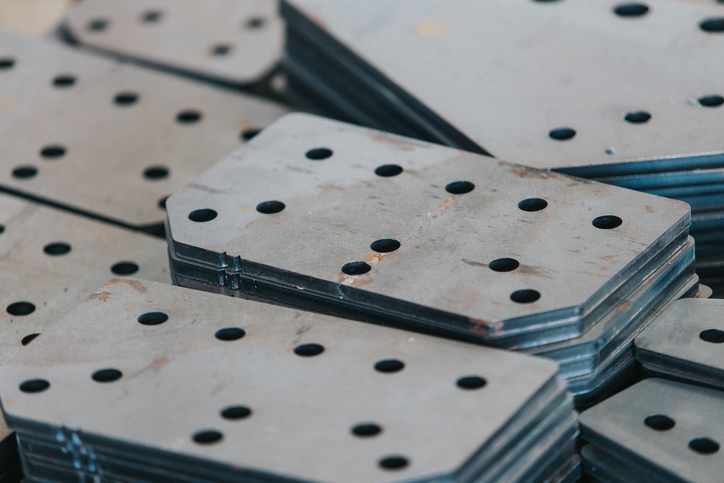
Sheet metal bending is a manufacturing process that involves shaping metal sheets into desired forms, without altering their material properties. This technique is essential in industries such as automotive, aerospace, construction, and electronics. Because in these industries precision-formed metal components play a critical role in product functionality and durability. This article explores what sheet metal bending is, its techniques, key factors, common challenges, and practical applications across different industries.
What is Sheet Metal Bending
Sheet metal bending is a precision-driven fabrication process that transforms flat metal sheets into precise angular or curved shapes using controlled force. Often integrated into metal stamping operations, this process relies on press brakes, folding machines, and roll benders to apply calculated pressure and reshape the material without compromising its integrity. The choice of material plays a crucial role, as properties like ductility, grain direction, and anisotropy influence bending behavior. Soft aluminum alloys allow for tight bends, while high-strength steels require larger radii to prevent cracking. Achieving precision also involves managing springback, where metals attempt to return to their original shape. For example, stainless steel may require overbending by 3-5° to compensate for elastic recovery. Advanced techniques, such as laser-assisted heating, help reduce stress and improve accuracy.
Sheet Metal Bending Techniques
Sheet metal bending utilizes different techniques that balance material adaptability to produce different products. The following sections review some of these techniques.
Folding (Wipe Bending)
The Folding technique clamps the sheet against a die while a wiping blade folds the exposed edges over the die. This avoids surface marring and direct contact between the tool and the exposed edge, hence, creating precise bends. They are applied in construction, such as architectural cladding panels with crisp 180° hemmed edges for structural rigidity. The folding technique is ideal for thin or pre-finished material and handles large flat panels efficiently.
Air Bending
Air bending uses a punch and die where the punch does not force the sheet metal entirely into the die cavity, thus, leaving an air gap. The bend angle is controlled by the depth of the punch descent. Therefore, allowing flexibility for multiple angles with a single tool. This technique minimizes tooling costs and suits low-to-medium production runs. Moreover, it is common to form HVAC duct panels with varying angles like 30° and 90°, using a universal V-die.
Incremental Bending (Step Bending)
Incremental bending gradually bends a metal sheet at multiple points to create large radii or complex shapes. This method, often CNC-controlled, allows precise shaping without the need for specialized dies. A common example is step bending, which forms wave-like or curved surfaces in architectural designs, such as sculptural stainless-steel facades.
Laser-Assisted Bending
A laser is used to locally heat the bend line, thus, reducing yield strength and enabling complex bends in high-strength material with minimal required force. This technique is good for complex bending. The medical industry uses laser-assisted methods to produce titanium spinal implant components with compound curves and bends without microcracking.
Roll Bending
Roll bending shapes metal sheets into curved or cylindrical forms using three adjustable rollers arranged in a triangular configuration. As the sheet passes through the rollers, pressure is incrementally applied to achieve gradual curvature. Moreover, this technique is capable of forming large-radius bends like arcs and cones in thick materials (up to 12mm steel). Roll bending is common in the production of storage tanks, industrial piping, curved roofing panels, and structural elements like arched steel beams in stadiums and bridges.
Coining
Coining is a high-precision bending technique that uses extreme force—three to five times higher than air bending—to press the metal into the exact shape of the punch and die. This process eliminates springback and also achieves ultra-tight tolerances (±0.01°) by permanently compressing the material’s grain structure. Coining is ideal for applications requiring sharp, burr-free bends, such as precision electrical contacts in circuit breakers.
Rotary Bending
Rotary bending employs a rotating die that pivots around a central axis to bend the sheet. Therefore, the sliding friction between the tool and the material is eliminated. Moreover, it preserves polished or coated finishes and enables tight tolerance. As a result, this makes it ideal for laptop hinges and decorative metalwork with flawless visual surfaces.
Factors Influencing Sheet Metal Bending
There are several factors that influence the success of sheet metal bending with details of some in the following sections.
Material Properties
A metal’s inherent characteristics such as ductility, anisotropy, work hardening, and yield strength dictate its bending behavior. Ductility determines how tightly it can bend without cracking. Anisotropy or directional grain structure from rolling, demands careful bend orientation, as orientation perpendicular to the grain minimizes fracture risk. Both yield strength and work hardening influence the force requirement and springback.
Tooling Dynamics
The geometry and material of punches and dies play a crucial role in achieving precise, high-quality bends. The punch tip radius determines the inner curve of the bend and must follow material-specific guidelines. For instance, stainless steel requires a minimum radius (Rmin) of 1.5 times the material thickness (T), while aluminum requires Rmin ≥ 0.8T.
- Die Opening Width: The width of the die opening (V = 6T to 12T) balances precision and force requirements. A narrow opening increases the risk of cracking, while a wider opening leads to greater springback.
Process Parameters
- Bending force: The bending force must align with the material tensile strength to avoid tool wear or incomplete bends.
- Springback: Refers to the elastic recovery of the metal post-bending. Because of springback, metals require intentional overbending to achieve target angles. For example, 3° per mm thickness for stainless steel.
- Speed: The bending speed influences heat generation, especially in sensitive alloys like magnesium. Slower bending reduces heat buildup, hence, preserving the material’s integrity and preventing structural weaknesses.
Sheet Metal Design and Geometry
- Bending Radius (R): The minimum inner radius achievable without causing material fracture. Moreover, this parameter is highly dependent on the sheet thickness (T). For ductile metals R ≥ T.
- K-Factor (K): This is a dimensionless ratio (0.3-0.5) that locates the neutral axis (the region neither stretched nor compressed). It serves in calculating the bend allowance (BA), on the basis of other critical parameters including the bend angle (A).
![\[ BA=\frac{\pi \times \left ( R\times K\times T \right )\times A}{180} \]](https://www.itdprecision.com/wp-content/ql-cache/quicklatex.com-4a5842bab8a835771029a8b5a4cb3a05_l3.png "Rendered by QuickLaTeX.com")
- Edge Distance: The edge distance is a rule that prevents tearing. Example 2T from the holes.
- Consistent radii: Avoids stress concentration in multi-bend parts.
Environmental and Operational Factors
- Temperature: The temperature influences residual stress, where cold bending risks distortion and heated dies (200°C-300°C) ease the forming of high-strength alloys.
- Lubrication: It reduces friction and galling, which in turn prevents the generation of heat.
- Humidity Control: This prevents hydrogen embrittlement in hygroscopic metals like magnesium.
Challenges in Sheet Metal Bending and How to Overcome Them
Below in a tabular form are the different challenges faced in sheet metal bending, the cause of the challenges, and how to overcome them.
| Challenge | Cause | How to Overcome |
| Springback | Elastic recovery post-bending. | Overbend angles, coining, FEM simulation. |
| Material Cracking | Tight radii exceed ductility, poor grain alignment. | Increase bend radius (≥1.5T for steel), bend perpendicular to grain. |
| Tool Wear | Abrasive materials or high-tonnage bending. | Tight radii exceed ductility and poor grain alignment. |
| Inconsistent Bends | Material thickness variation, tool misalignment. | CNC press brakes, laser alignment, material certification. |
| Complex Geometries | Tight tolerances, multiple bends. | Modular tooling, laser-assisted bending, step-bending. |
| Surface Scratches | Friction between tool and material. | Non-marring tool materials, polished dies, lubricants. |
| Edge Tearing | Bends near edges or holes. | Reduce speed, laser-assisted heating, and temperature-controlled dies. |
| Thermal Distortion | Heat buildup in sensitive alloys. | Reduce speed, laser-assisted heating, temperature-controlled dies. |
| High Material Waste | Trial-and-error adjustments, poor nesting. | Optimize flat patterns with CAD/CAM and nesting software. |
| Difficulty with Hard Alloys | High yield strength resists bending. | Use higher tonnage hydraulic presses, pre-heat, or anneal. |
Applications of Sheet Metal Bending
Different industries use sheet metal bending in one way or another as the following sections highlight.
Automotive Industry
Sheet metal bending is essential for shaping lightweight yet robust structural components such as chassis reinforcements, body panels, and brackets. These bends ensure the vehicle’s safety standard while optimizing weight for fuel efficiency.
Aerospace Industry
The process crafts aerodynamic and load-bearing parts like fuel system components and airframe structures from high-strength alloys. With precision bending, it ensures reliability under extreme operational stress such as turbulence as well as temperature fluctuations.
Consumers Goods Manufacturing
Metal sheet bending is useful in producing enclosures, heat sinks, and mechanical assemblies. In addition, it achieves micron-level accuracy for compact designs in electronics, appliances, and machinery.
Energy and Infrastructure
It is critical for forming piping systems, turbine components, and renewable energy structures. Moreover, uniform bends ensure stress resistance and longevity in high-pressure and corrosive environments.
Medical Industry
Metal sheet bending enables the fabrication of sterile, burr-free surgical tools and implantable hardware. Precision bends adhere to biocompatibility standards as well as provide the necessary tolerance for patient safety.
Sheet Metal Bending at ITD Precision
At ITD Precision, we understand that quality stampings require superior tooling, skilled personnel, and robust systems. This is why we have continually invested in these for the past 70 years so that we can always deliver high-quality products. Bringing your sheet metal bending or stamping needs to ITD Precision is the best decision you can make today. Contact us now, and we can get started on your project in no time.