Introduction: Understanding the Challenge of Molding Undercuts
In the complex and intricate world of injection molding, part design is a constant balance between ideal geometry and producible reality. This challenge becomes particularly pronounced with complex features known as undercuts, which prevent a molded part from being directly ejected from a standard two-part mold. These design elements create hidden recesses and internal protrusions that lock the part firmly in place. The difficulty increases significantly in insert molding, where a metal component is encapsulated within a plastic. Moreover, the presence of this grid insert severely limits the options for flexible mold components or complex tooling actions that would normally release a stubborn undercut. This article reviews why molding undercuts occur, types, and design/tooling solutions, providing actionable strategies to create high-quality insert-molded components.

What Are Undercuts in Insert Molding?
An undercut in insert molding is any plastic geometry that creates a mechanical lock against ejection. This occurs when molded material forms a recess or protrusion behind the metal insert’s profile. Such features trap the assembly by obstructing the essential straight-line demolding path. These obstructions can be internal within the assembly or external on its surfaces. They may be intentional for part use or function, or they can be unintentional design flaws. Ultimately, undercuts cause parts to stick firmly in the tool. This sticking leads to potential damage during forced ejection procedures. It also significantly increases the final or overall mold complexity and project costs for the client.
Why Molding Undercuts Occur
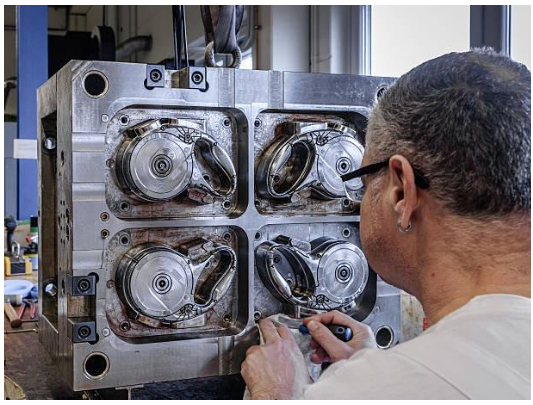
Undercuts generally happen when critical part features, such as snap-fits, threaded sections, or sealed interfaces, logically block the direct mold opening path. While some undercuts are intentionally designed for specific performance reasons, many occur due to inadequate draft analysis during early design stages. Fortunately, most undercut issues can be effectively addressed through systematic and smart design for manufacturing (DFM) principles. Common techniques include adding sufficient draft angles to vertical walls, utilizing side actions and lifters within the mold, and reorienting the part in the mold that naturally reduce complex tooling requirements. This approach successfully resolves undercut problems while maintaining the part’s functionality and design integrity.
Types of Undercuts in Molding
Internal Molding Undercuts
Internal undercuts are hidden within a part’s structure, often forming an interior lip, groove, or thread. These features lock the part into the core of the mold, making direct ejection impossible. Standard solutions involve collapsible cores or internally acting lifters that retract inward to release the trapped geometry. This type of undercut is particularly challenging to visually inspect and often requires complex, high-precision tooling mechanisms to function reliably.
External Molding Undercuts
External undercuts are features located on a part’s outer surface that prevent easy mold opening. These often include recessed logos, side holes, or snap-fit hooks on side walls. Such features require specialized mold parts, such as a sliding side-action part and split cavities that move perpendicular to the main opening direction. This added tooling complexity is necessary to clear the obstruction before the part can be ejected from the mold cavity.
Hole and Window Undercuts
Any through-holes or openings oriented perpendicular to the mold’s draw direction create a clear undercut. This includes simple lateral holes, complex-shaped windows, or C-channels that trap mold steel. Solutions range from side-acting core pins that form the hole to more complex “bump-off” features designed for slight plastic deformation during ejection.
Insert-Specific Undercuts
Unique to insert molding, this type occurs when plastic flows into a recess or behind a flange on the metal insert itself. The molded material then mechanically locks the insert within the plastic, preventing the entire assembly from releasing. Mitigation requires meticulous insert design. Often involving strategic gaps or tapers to ensure a clean ejection path. This is one of the most critical undercuts to address in the design phase.
Impact of Undercuts on the Molding Process
- Design Limitation: Undercuts severely restrict design flexibility for both plastic and metal components. The insert’s geometry must accommodate mold actions while maintaining structural integrity. This often requires compromise between ideal design and manufacturable reality.
- Process Reliability: The interaction between moving mold components and metal inserts creates multiple potential failure modes. This includes insert displacement during molding and wear on delicate mechanism components. Such reliability concerns directly affect production consistency and part yield.
- Production Integrity and Production Quality: Undercuts can cause drag marks, stress concentrations, and potential damage during ejection. In insert molding, this jeopardizes the critical bond between plastic and metal. Maintaining consistent part quality becomes increasingly challenging with complex undercuts.
Common Design and Tooling Solutions for Managing Undercuts
Bump-Offs (Hand-Loaded Inserts)
Bump-offs rely on a part’s slight flexibility to eject over minor undercuts. The molded material temporarily deforms to clear the obstruction during ejection. This solution works only with flexible materials and shallow undercut depths.
Side-Actions (Slides)
Side actions are movable mold components that travel perpendicular to the main opening direction. These cam-activated slides retract before part ejection to clear external undercuts. They are ideal for features like side holes or snap fits. Proper lubrication and wear plates are important for their long-term reliability in high-volume production runs.
Parting Line Redesign
Strategic parting line placement can naturally eliminate undercuts by aligning them with the mold’s opening direction. This fundamental design approach often provides the most elegant solution. It requires early collaboration between the design and tooling engineer to optimize part orientation.
Collapsible Cores
Collapsible cores are segmented tools that retract inward to release internal threaded features. These sophisticated mechanisms enable the molding of internal threads without manual intervention. While costly, they provide the only practical method for high-volume threaded parts.
Design Strategies to Minimize or Eliminate Molding Undercuts
Strategic Draft Angle Application
Incorporating sufficient draft angles on all vertical walls will facilitate easy part ejection. A minimum of 1-3 degrees per side dramatically reduces ejection forces. This simple modification often eliminates minor undercuts while improving surface finish across all part geometry.
Snap Fit Redesign with Access Slots
Replacing traditional snap fits with modified designs featuring ejection access slots allow the mold core to protrude through the snap arm during demolding. The snap features then flexes normally during assembly while remaining manufacturable with simple straight-pull tooling.
Parting Line Optimization
Strategically positioning the parting line at the largest cross-section of the part aligns the mold opening direction with potential undercut features. Careful parting line placement can naturally eliminate complex external undercuts without requiring additional tooling actions or mechanisms.
Material Flexibility Utilization
Select an engineering material with inherent flexibility to enable “bump-off” ejection over shallow undercuts. This approach works particularly well with polypropylene, nylon, and other ductile polymers. The material’s temporary deformation during ejection eliminates the need for complex side actions.
Best Practices for Tool Designers and Manufacturers
- Efficient Cooling: Design conformal cooling channels that work around undercut mechanisms to ensure uniform part cooling.
- Prototype Testing: Validate all moving components with mold flow analysis and prototype tools before final production.
- Early DFM Collaboration: Involve tooling engineers during initial design to identify and resolve undercuts before tooling begins.
- Strategic Parting Lines: Place parting lines at the largest cross-section to naturally eliminate complex external undercuts in the mold.
Why ITD Precision Excels in Managing Undercuts
ITD Precision excels at managing complex undercuts through decades of specialized insert molding expertise. Our in-house tool and die capability, supported by precision CNC machining and advanced simulation, ensures robust solutions. We leverage a comprehensive design-for-manufacture consultation to precisely and proactively eliminate undercut challenges before tooling begins. This integrated approach, backed by IATF 16949 certification, guarantees efficient, defect-free production of the most intricate components. Contact us to transform complex part design into manufacturable, high-quality realities.