The primary function of any seatbelt is to restrain you in your seat during a sudden stop or impact, and for this, it relies on several key parts. This article reviews parts of a seat belt system, how they work, types of seat belt systems, and how they are made.
Seat Belt Parts
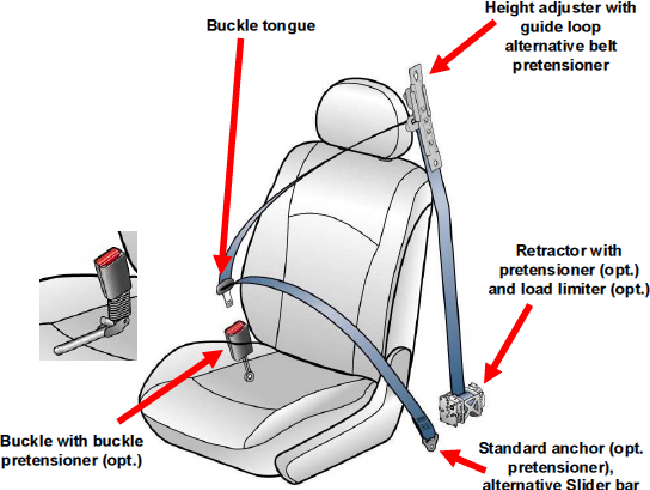
Generally, a standard seat belt system consists of four key components that work in unison to restrain occupants during a collision and prevent serious injuries.
Webbing
The webbing is the strap that extends across the occupant’s body and secures them in place. It is typically made from high-strength polyester due to its durability and ability to withstand high forces experienced during accidents.
Buckle Mechanism
The buckle is the mechanism that secures the two ends of the seat belt together. It consists of a latch plate (the part that is inserted into a receiver) and a release button that allows for quick unbuckling in emergencies. The design of buckles is for both ease of use and security, featuring mechanisms that can withstand significant forces during a crash..
Retractor Assembly
The retractor is a critical component that allows the seat belt to extend and retract smoothly. It incorporates a spring-loaded spool, which keeps the webbing taut during normal use. The retractor also features a locking mechanism that engages during sudden deceleration or rapid movements to prevent the webbing from extending further.
Anchor Points
Anchor points are the specified locations within the vehicle where the seat belt is secured. They play a vital role in ensuring that the seat belt maintains its position and can effectively restrain the occupant. Proper anchor point placement is crucial for effective load distribution across the occupant’s body during a crash.
Pretensioner
Pretensioner is a safety device that tightens the belt during a sudden stop or collision. They can deploy in a variety of crashes, including frontal, side, rear, and rollover crashes. Also, pretensioners could be located in various parts of the seat belt system including anchor, retractor, and buckle. Some vehicles only deploy the pretensioner if the seat belt buckle is active, with the most common activation mechanisms as follows:
- Mechanical Pretensioner: Relies on spring-loaded or mechanical force to remove belt slack. Less common in modern vehicles, it depends on mechanical energy storage and release mechanisms.
- Pyrotechnic Pretensioner: Utilizes a small explosive charge to create rapid mechanical movement. It could be either in the retractor or buckle, and offers the fastest activation method, triggering within milliseconds of detecting a collision.
- Electric Pretensioner: Uses an electrical sensor and enables connection to other safety systems like airbags and rollover sensors. Thus, preventing false locking that can occur with mechanical pretensioners. In comparison to pyrotechnic systems, it provides a slower but more controlled activation.
Seat Belt Parts Diagram
How Do Seatbelts Work
When a vehicle is in motion, the driver and passengers travel at the same speed. In the event of a collision, however, the vehicle comes to an abrupt stop while the occupants continue to move forward due to inertia. This is where the seat belt system comes into action.
Initial Detection
The vehicle’s sensor system immediately recognizes the potential impact. Advanced sensors monitor multiple parameters, including vehicle speed, deceleration rate, and collision proximity. These sophisticated technologies work milliseconds before actual impact occurs.
Inertia and Restraint
As the vehicle stops suddenly, the webbing of the seat belt applies a restraining force against the passenger’s body. This force counters the momentum, preventing occupants from ejecting their seats or colliding violently with interior structures such as the dashboard or windshield.
Locking Mechanisms
Seat belt retractors contain locking mechanisms to help secure the occupant in place. These can function depending on either inertia or webbing movement:
- Inertia Locking Mechanism: An inertia locking mechanism uses a pendulum that swings forward during rapid deceleration, hence, engaging a latch that locks the retractor spindle. This prevents the belt from unwinding further during a collision.
- Webbing Movement Lock: Some systems include a centrifugal clutch that locks the belt whenever there is rapid pulling. This mechanism ensures that any sudden movement triggers the lock, thus, enhancing safety readiness.
Pretensioner Activation
As the collision becomes inevitable, the pretensioner springs into action and rapidly tightens the seat belt, removing any existing slack. It pulls the webbing closer to the occupant’s body eliminating the potential forward movement space.
Load Limiting
Load limiters work in conjunction with pretensioners. They allow a small amount of webbing to spool out during a crash on reaching a certain load. This controlled slack helps reduce the force exerted on the occupant’s chest, decreasing the risk of injury from the seat belt itself.
Post-Impact Stabilization
After the primary impact, the seat belt continues its protective role. It holds the occupant in a safe position, preventing secondary movements. This stabilization is crucial in multi-stage collision scenarios.
Types of Seat Belt System
Seat belt systems are available in various configurations, each designed to optimize safety and comfort based on the vehicle type and intended use. The following sections highlight the most common types.
Two-Point Belt
These belts attach at two points, typically across the lap. While effective for restraint, they do not provide the same level of protection as more advanced systems. Two-point belts are prevalent in older vehicles and are less common in modern designs due to safety concerns.
Three-Point Belt
This is the predominant type of seat belt system in modern vehicles. It attaches at three points: one on the shoulder and one on either side of the lap. This design provides superior restraint during a collision, distributing forces across the body’s stronger areas, such as the pelvis and ribcage. The three-point system is mandatory in passenger vehicles due to its effectiveness.
Four-Point (Harness) Belt
Typically used in racing cars and child safety seats, these harnesses provide additional restraint locations, generally including two shoulder straps and two or more lap straps. They secure the occupant more effectively, preventing excessive movement during high-impact situations. These systems provide enhanced protection for specific scenarios, such as high-speed racing or the unique body requirements of infants and small children.s.
Inflatable Seat Belt
An innovation in seat belt technology, these belts incorporate inflatable sections that expand upon impact. This feature helps distribute crash forces over a larger body area, reducing peak pressures on the occupant and enhancing protection during collisions.
How Seat Belts are Made
The manufacturing process of seat belts is complex, demanding rigorous testing and adherence to safety standards. Here are the fundamental stages of seat belt production.
Material Selection
The choice of materials is critical for ensuring strength and durability. Most seat belt webbings consist of 100% polyester, while buckles and retractors typically utilize high-strength metals such as steel. The shift from nylon to polyester reflects advancements in fiber technology and recognition of performance metrics.
Weaving the Webbing
The polyester fibers undergo a weaving process to create the belt webbing. Modern looms can produce up to 3,000 picks per minute, allowing for tight, dense weaves that enhance the tensile strength of the belt. This process involves creating a herringbone or twill weave pattern, which provides the necessary elasticity and strength.
Forming Buckles and Retractors
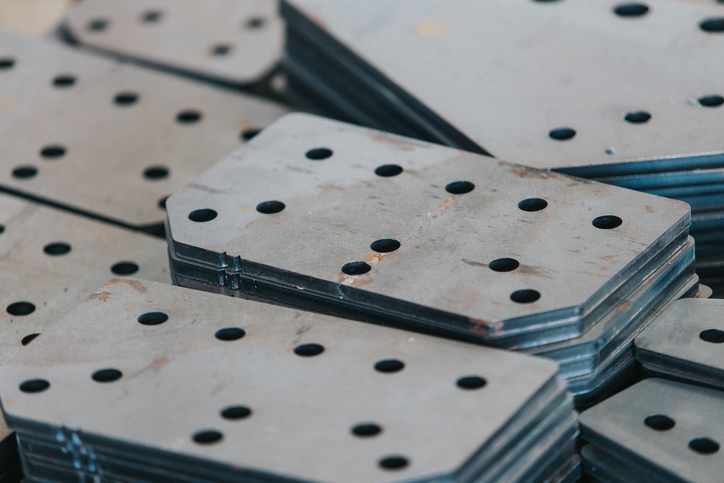
Buckles are manufactured using stamping and insert molding processes to shape the metal components accurately. The retractor mechanisms involve assembling intricate parts including the spool, springs, and locking systems, to guarantee smooth operation and reliability.
End Assembly and Testing
Once all components are created, they are assembled into a complete seat belt system. The seat belt assembly is then subject to rigorous testing, including dynamic crash tests, to ensure they meet or exceed safety standards. Testing evaluates the belt’s performance across a range of potential crash scenarios to validate the effectiveness of the design.
Quality Assurance
Throughout the manufacturing process, quality checks are crucial. Every batch of seat belts undergoes inspection to ensure they meet industry standards for strength, durability, and safety. This includes tests for tensile strength, stretchability, and resistance to wear and tear.
ITD’s Manufacturing Excellence
At ITD Precision, our insert molding capabilities distinguish us in the manufacturing of buckles for your seat belt system. We leverage sophisticated equipment including precision molding machines and integrated quality control systems. Thus, delivering seat belt systems that achieve unprecedented levels of safety, reliability, and performance across diverse operational environments. Contact us today for more details.