Stage tooling is a vital component in manufacturing, particularly in processes requiring precision and efficiency. This article explores what stage tooling is, its benefits, disadvantages, as well as the differences between stage and non-stage tooling.
What is Stage Tooling
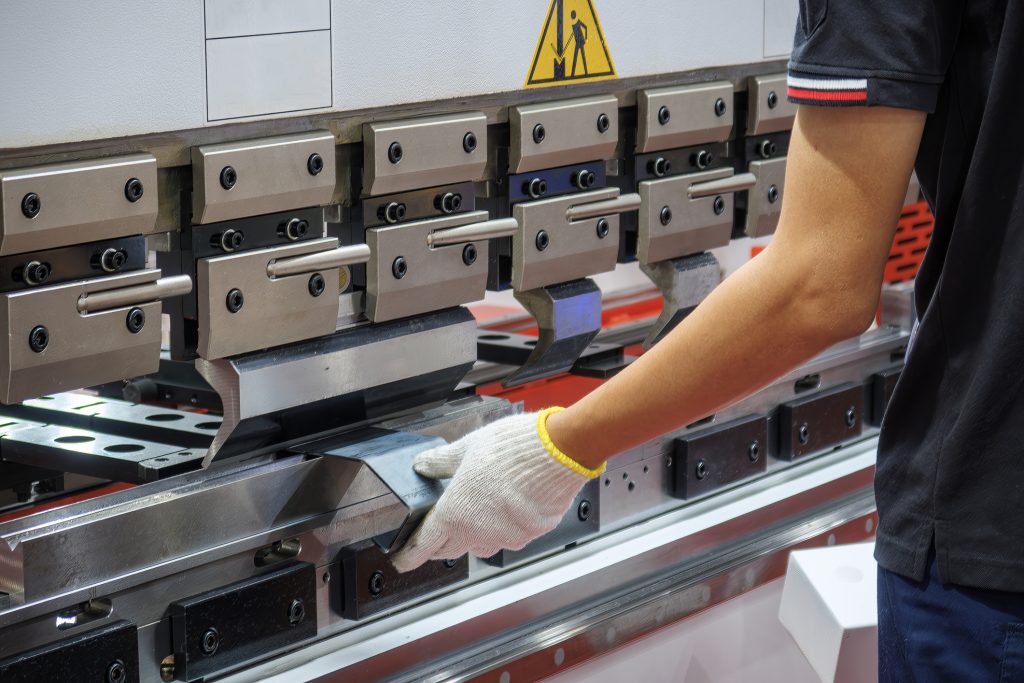
Stage tooling, or common shut height tooling, refers to a setup where tooling shuts at the same height. Meaning that multiple sets of tools can be set up at the same time without the risk of dies and punches colliding. Hence, eliminating the need for repeated material handling, shimming, and utilizing multiple setups.
One common application of this fabrication approach is in the bending of sheet metal parts in a process also referred to as press brake tooling. In press brake tooling an operator is able to use different style of tools such as a flattening block, 30° dies, and 75° dies in a single progressive operation. To achieve this, the operator will need to set these tools to have a common shut height before commencing. As a result, the operator will be able to carry out multiple bending operations without putting the part down, which is ideal in the industry.
Stage Tooling Benefits
Adopting this approach in manufacturing comes with a lot of benefits, as the following sections highlight.
Cost Efficiency
For low to medium volume production runs, stage tooling can be more cost-effective than investing in progressive metal stamping. The initial tooling costs are lower, and manufacturers can achieve high-quality results without the need for extensive capital investment.
Precision and Control
Stage tooling offers exceptional precision and control over each manufacturing operation. By dedicating a specific tool to each task, manufacturers can fine-tune processes to achieve the desired tolerances and specifications. This level of control is crucial for industries such as aerospace, medical devices, and automotive, where component accuracy directly impacts performance and safety.
Simplified Workflow
Stage tooling offers a straightforward manufacturing process. By simplifying the operations, it reduces the complexity associated with tooling adjustments, machine programming, as well as maintenance. This aspect is particularly appealing for smaller manufacturers or those new to the metalworking industry.
Cons of Stage Tooling
While this method of fabrication offers several benefits, there are some drawbacks to consider.
Longer Production Time: One of the primary drawbacks of stage tooling is the longer production time. Since each part must go through multiple tooling setups, the overall process is slower in comparison to progressive metal stamping, where several operations occur simultaneously. Hence, this process is not ideal for high volume production.
Labor Intensive: Requires more handling and transfer of parts between different tools. This increases the need for highly skilled labor, and also heightens the possibility of human error in comparison to progressive metal stamping.
Stage vs Non-Stage Tooling
Although stage tooling represents an advancement in manufacturing, there are applications that still warrant the use of non-stage, or single stage, tooling. The following sections highlight some of their differences

Basic Setup
| Stage | Non-Stage |
| Setup is more complex, because the shoulders of dies are typically at the same height, punches and dies will collide if different tools are used in the same setup. So, the operator needs to take out time to adjust the tools to have a common shut height. | Generally requires less complex setups. The simplicity of the machinery and tooling allows for quicker adjustments and configurations, which is especially useful in environments where changeovers between different parts need to happen frequently. |
Efficiency and Production Volume
| Stage | Non-Stage |
| Excels in producing parts in larger quantities. It minimizes operational costs per part and can easily integrate automation and continuous feed processes, which are crucial in high-demand environments. For example, applications in the automotive and electronics sectors benefit significantly from this method. Manufacturers can efficiently produce complex components like brackets, connectors, and housings while maintaining tight tolerances. | Generally, more efficient for lower production volumes due to its simplicity and lower initial setup costs. It is ideal for high-mix low-volume (HMLV) production scenarios where different parts may be produced in smaller batches. The reduced setup and operation complexity allows for better flexibility in changing product designs quickly |
Cost Considerations
| Stage | Non-Stage |
| Involves higher initial investments due to the complexity of designing and manufacturing the die sets. However, manufacturers often enjoy reduced tooling costs per part in the long term, especially when producing high volumes. Its ability to accommodate intricate designs through multiple operations makes it valuable in sectors that demand versatility. | In contrast, this requires less initial investment and is less complex, making it more accessible for smaller businesses or projects. This method’s straightforward design enables quicker setups, facilitating easy adaptation to production changes. Nonetheless, the cost per part tends to be higher in the long run, particularly in larger production runs. |
Stage Tooling at ITD
Choosing between stage and non-stage tooling involves weighing factors such as production volume, part complexity, and overall manufacturing efficiency. So, it is necessary for manufacturers to have a clear understanding of these processes and the client’s needs. At ITD, we boast of decades of experience in delivering high-quality metal stamping products using both approaches. Contact us today and be sure of a genuine partner in delivering your fabrication needs.